
The Perpetual Bell Jar: Ovid, Plath and Sartre

Updated: Feb 9, 2025
Much-needed respite from Los Angeles's metropolitan maze comes in 8-ounce servings—warm vanilla, rich coffee grounds, and a kick of mint coalesce into a drearily overpriced (yet indisputably hearty) homecoming-in-a-cup.
As self-proclaimed coffee connoisseurs, my two closest hometown friends and I waft our Mint Mojitos (House Way: extra cream, extra sweet) from the Philz Coffee across from our old high school, comically darting around the plaza in attempts to ward off the ghosts of classmates past. While I would normally roll my eyes and laugh at such a sentiment, I can't think of a better way to describe our dynamic than in a way that would make Ovid roll over in his grave in Romania—land and sea and air, equipoised.
"All objects were at odds, since in one mass
Cold essence fought with hot, and moist with dry,
And hard with soft and light with things of weight."
Though Ovid had described these warring elements as "strife," I couldn't think of a better balance between the three of us—Stella, as poised and calm as the sea and with depth grander-still. Ziran, whose presence fills a room with crackling electricity and compelling tension. As for myself—I can only hope to emulate the gravity with which the land grounds those seeking respite (or good conversation). In a loosely Neo-Classical sense, we make a pretty darn good prehistoric Earth.
During one of these meetups, Stella enters the coffee shop with a book in hand—neatly packaged in rainbow-striped wrapping paper, it has a comfortable weight to it. As I carefully unwrap its cover, she describes the protagonist of the novel: a young literary magazine writer navigating womanhood, New York (ugh), and her career as she reconciles her relationship with the ever-shifting web of people (i.e. men), power (i.e. men), and pejoratives (i.e. men) surrounding her. "Sylvia Plath," she explains. "Similar to Charlotte Perkins Gilman." I was intrigued. Female delirium in the 1900s, though greatly unfortunate given the severe lack of psychological and psychiatric resources and social stigma against mental illness, became an act of rebellion of sorts for the very same reason. The works left behind by these authors were the sole remnants of a generation of women whose stories went untold.
Radical, compelling and above all, stifling (Plath's intent, no doubt), The Bell Jar invoked a reckoning similar to that of a fish realizing that it had been swimming in a substance called water for its life's entirety. In the short winter break I had spent buried in its pages, my metaphorical Bell Jar seemed to have materialized out of thin air despite it having been indisputably present for all of my life. I wondered how it may have affected my day-to-day operations in the subtlest of ways—how, despite sheltering me from harsher elements, it has also inevitably obstructed my other senses. How many times have I prodded at the edges of my Bell Jar and trudged along its curved edge in mind-numbing circles (quite like Gilman's protagonist repeatedly scaling her prison-room in The Yellow Wallpaper) while believing that I had been making linear progress the entire time?
Months later, I pick up another paperback—noticeably thinner in print but no lesser in significance.
In his 1946 work, Existentialism is a Humanism, the French philosopher Jean-Paul Sartre famously proclaimed that "l'existence précède l'essence"—existence precedes essence. An advocate of self-realization, Sartre argued that he who exists is free to define his being without the notion of a predetermined fate. In Sartre's philosophy, a can opener is a can opener due to its function—it opens cans, and its essence consequently precedes its existence. Humans, on the other hand, are blank slates, perfectly-poised for determinism yet condemned to be free.
The idea of the individualistic self was something of a consolation prize—an apology of sorts for the turmoil brewing in the Bell Jar. If only novels could speak, Existentialism is a Humanism would push its metaphorical glasses further up its nose and tell me, "There, there. The Bell Jar can be scaled or, better yet, removed in its entirety! Isn't that fabulous?" while Plath's would fume in passive rage.
One can only hope Sartre is right. One can only hope the Bell Jar is semi-permeable, selectively letting in things we render good and shielding us from the bad. But the truth is that we oftentimes operate within concentric Bell Jars—and some of these metaphorical encasings exist not only for individuals, but entire communities as they face social and structural determinants which place limitations on the self-determination championed by Sartre.
A recent panel about global health with Weill Cornell Medicine's Dr. Joseph Shin helped bring this consideration into perspective—for example, it is not fair for under-resourced communities or communities which experience cyclical unemployment/poverty to be told that individualism is a panacea for all the deeply-ingrained problems they face (it's a very Herbert Hoover-esque "pull yourself up by the bootstraps" mentality). Instead, I hope to continue educating myself about how structural determinants (of health, of education, etc.) can be actively addressed through sustainable and individually-tailored models.
Maybe it's fine to seek refuge in the Bell Jar once in a while, or to feel especially can-opener-ish on particular days. But an amalgamation of the two figures' philosophies—both Sartre and Plath—act as caveats against falling into complacency in either.
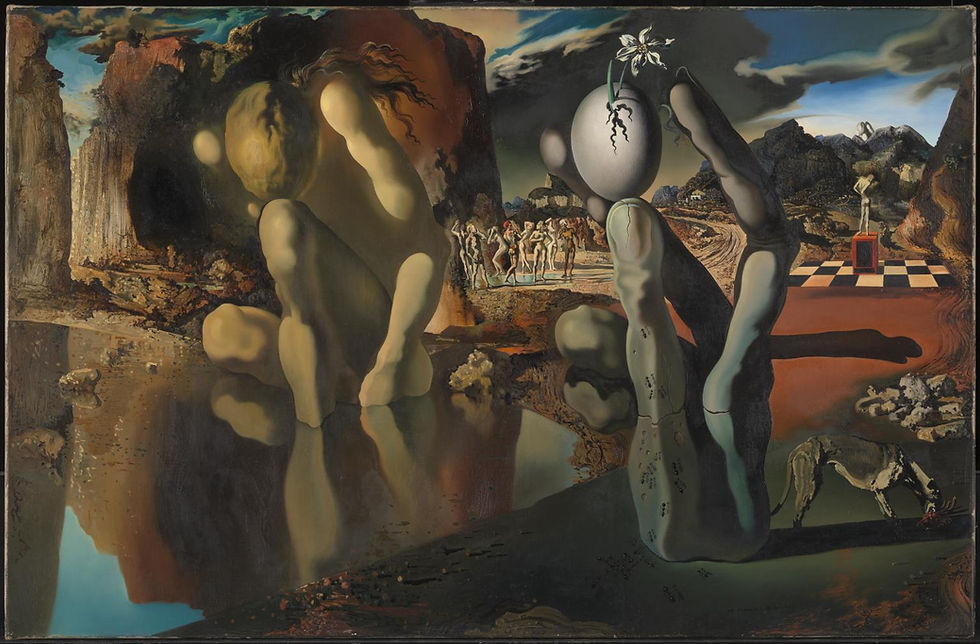
Salvador Dali on Ovid's Metamorphoses; Narcissus



Comments