
The Apollonian-Dionysian Dichotomy: Opposing Nietzschean Dualisms

Updated: Mar 8, 2023
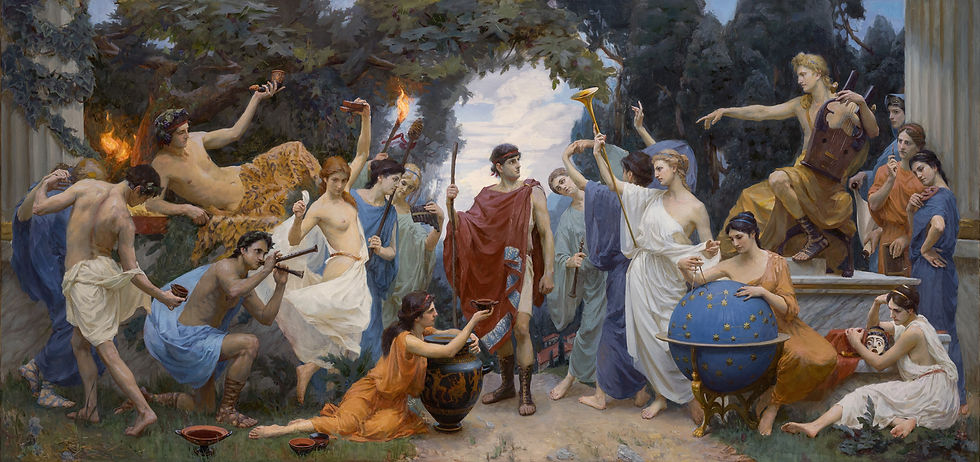
Juxtaposition within a character’s state of being—seemingly-contradictory dualisms which occupy one’s conscience—creates simultaneous dissonance and depth within a literary work as the character reconciles multifaceted renditions of their own identity. In his 1872 work, The Birth of Tragedy, the German philosopher Friedrich Nietzsche popularizes two dualisms which are particularly widespread throughout Greek Tragedy: the Apollonian and Dionysian. Although the Apollonian, who appeals to rationalism and logic, and Dionysian, who instead epitomizes emotion and instinct, reside on opposite spectrums of the dichotomy, the two tropes are not thought to be mutually exclusive nor direct antitheses from the other, and are rather inextricably intertwined. Notable examples of the dualism are presented in Sophocles’ Antigone and Euripides’ Bacchae, in which the contrasting identities are present in both a singular character (Antigone, Pentheus) as well as the protagonists’ respective counterparts (Ismene, Dionysus). In Antigone, the dissonance created by the protagonist’s simultaneous self-determination and external locus of control parallels that of the incongruity between Pentheus’s brash egocentrism and rational restraint in Bacchae—collectively, however, these characters’ similarity lies in that they stand in stark contrast to their Apollonian and Dionysian counterparts, Ismene and Dionysus.
In Antigone, Sophocles’s protagonist is revealed to possess contradictory self-reliance and belief of predeterminism—Antigone’s fluid outlook on her own autonomy (as a woman and a member of Oedipus’s lineage) allows her to oscillate between the Apollonian affinity for free will and Dionysian submission to homogeneity borne from collective disorder. Initially under the impression that her circumstances are shaped by her father’s sins and the subsequent wrath of immortal beings, Antigone inquires to her sister in the second line of the play, “What evil left behind by Oedipus will Zeus not bring to pass while we still live?” Within Antigone’s laments lie allusions to her powerlessness in decision-making and her resulting passivity—continual references to Oedipus’s “thrice-turned fate” and the “evil left behind” by her father suggests she is burdened by the sins of her forebears to such great extent that her individual autonomy is impacted. However, despite these notions of ‘fate’ and inherited misfortune, Antigone exhibits Apollonian self-determination as she foregoes the laws of the city and disobeys Creon’s burial mandates, claiming that, “[Creon] has no right to keep [herself] from [her] own [kin].” Simultaneously, Antigone’s lack of reverence for the laws of the polis correlate with Dionysian reliance on chaos over order and instinct over rationality, resulting in dissonance between the coexisting dualisms. Through her individualism and decided disobedience towards her uncle, Antigone displays both Dionysian and Apollonian qualities—however, a greater contradiction between the two identities lies in her decision to bury her brother, Polyneices: Antigone stands firm in her belief that proper burial of the deceased will garner approval from immortal beings, even daring Ismene to “dishonor what’s honored by the gods” by forgoing their brother’s burial. Antigone’s reverence for religious righteousness is contradictory to her open defiance of the laws underlying Creon’s polis—a Dionysian act by nature. This paradox, illustrated by Antigone’s confession that her own “piety has made [her] impious” in the eyes of the living, creates discord between her warring identities, and is not unlike the internal strife caused by opposing Nietzschean dualisms within Pentheus, the king of Thebes in Bacchae.
Although claiming to possess virtue, morality, and Apollonian rationale, the young Theban king in Euripides’s tragedy eventually succumbs to rashness and Dionysian indulgence, resulting in the convergence of contradictory ideals within a single character. Pentheus, having inherited the throne from his father, Echion, claims he intends to restore order to Thebes following Dionysus’s arrival—in an attempt to curb the “Bacchic wickedness” overrunning the city, he appeals to civic law and regulations, imprisoning believers of the new god. In a declaration to Cadmus and Tiresias, Pentheus asserts, “I have arrested some of [the followers of Dionysus]; my men / have them in chains, hands bound, in the common jail. / The ones that got away, I’ll hunt them down.” Pentheus utilizes the law in conjunction with his status as an aristocrat in attempts to construct Apollonian lawfulness amidst uncontrolled, Dionysian chaos. However, despite expressing his intent to establish order within the polis, Pentheus’s impetuous and self-indulgent nature eventually overtakes his Apollonian virtues. Overcome by sexual curiosity, he admits to Dionysus in stichomythia: “I’d pay a pile of gold to see [the women...] / I just can’t wait [...] / I can see them in the bushes now, / like mating birds, enmeshed in nets of love,” thereby succumbing to the dissolution of boundaries. The evident conflict of interest between Pentheus’s duty and curiosity leads to his affinity for the Dionysian principle of excess—driven by selfish desire and lust, the Theban king claims he would “pay a pile of gold” to see the maenads, characterizing him as an ostentatious and undisciplined ruler.
In Greek Tragedy, Nietzsche claims, the Dionysian and Apollonian are inseparable not only when the dichotomy exists within individual characters, but also amongst multiple figures and their counterparts. One of Antigone and Pentheus’s similarities lies in their interactions with characters on opposite ends of the Apollonian-Dionysian dichotomy: unlike Antigone, whose brazen determination to bury Polyneices counteracts the mandates instituted within the polis, her sister, Ismene, demonstrates an Apollonian reverence for public order. While defending her decision to forego burying her brother, she appeals to the citizens of Thebes, claiming, “I’m not dishonoring [the dead]! I simply can’t act against the wishes of the citizens,” revealing her desire to maintain decorum within Thebes by concurring with public opinion. Dionysus can be thought of as Pentheus’s Nietzschean counterpart, as the latter’s Apollonian deference for structure and control experiences a gradual decline following his exchange with the god of revelry. Pentheus’s skeptical and law-enforcing demeanor shifts in its entirety with a singular, “Wait!” from Dionysus, leaving the Theban king with little inhibition or restraint.
Literary parallelism within Ancient Greek tragedy is created by balancing opposing energies within a text across multiple figures—in the case of the Apollonian-Dionysian dichotomy, however, rich nuance and internalized conflict also stem from polar identities within a singular individual, resulting in complex contradictions which are representative of the world at large.


Comments